
What Culpeper Resident Lookup Confirms
Every record answers a different question. Match the source to the fact. A Culpeper resident lookup succeeds when county assessment and map records identify a recorded owner, the parcel, the physical situs, and the tax-roll mailing address for a property. The Virginia Citizen Portal serves a different purpose. It lets one person review that person's own registration and election details, and it is not a public name list. Court, vital, probate, and affiliation records cover still other questions, and none alone proves a common name is the right person.
| Record | What it can confirm | Custodian or search | Access route |
|---|---|---|---|
| Assessment and parcel map | Recorded owner, parcel, situs, mailing address, and map context | Culpeper Vision assessment database and County WebGIS | Free online search; Assessor handles corrections |
| Land record | Party roles, legal description, instrument, and transfer date | Circuit Court SRA and Clerk books | Free index; image, counter, or copy route varies |
| Court index | Case entry, court, dates, charge, and Code Section | Virginia case information | Public informational index with exclusions |
| Vital index or certificate | Birth, death, marriage, or divorce event | Virginia Department of Health | Index and certificate rules differ by record age |
| Public affiliation | Entity role or professional credential | SCC CIS or DPOR | Free public search, subject to update limits |
Begin with the record closest to the fact. An address points first to the county's Vision or WebGIS mapping tools. A case number belongs in the court system. Family-event questions go to VDH or historical archives. When one name appears in two places, compare location, dates, middle initial, suffix, parcel or instrument number, and any lawful relationship detail before calling it one Culpeper resident.
Build a Culpeper Resident Grid
Same-name confusion is common in any residents directory. Build a short identity grid before opening more records. List the name exactly as written, plus alternate spellings, initials, suffixes, a known or mailing address, and independent dates. Culpeper's assessor data keeps the physical situs separate from the tax correspondence address, so keep them in separate notes. A mailing address only shows where tax mail goes.
- Situs address
- The physical location of the parcel shown on the Culpeper tax map.
- Parcel or tax-map number
- The county identifier that ties an assessment result to a mapped property and often to land-record research.
- Instrument number
- The identifying number for a recorded land document, useful when requesting a particular item from the Clerk.
- Independent date
- A date from a separate record, such as a hearing or recorded transfer, used to test whether two entries could concern the same person.
The strongest Culpeper resident lookup rests on agreement among records created for different purposes. A parcel name alone is not enough. A matching court entry still needs a date or address link. Recorded ownership matters here. The person may not be a recorded owner. The public parcel layer may never name that person. The answer may then be limited. A court, vital, historical, or public filing result might exist. No releasable result may exist at all.
Note: Save the search date with each result, since assessment data, court entries, and registration status can change after a correction or a move.
Culpeper Court Lookup Fields
The Virginia Online Case Information System is the first name-based court check for a Culpeper resident lookup. Search by name, case number, or hearing date. Filters narrow results by court level and locality. General District searches use the selected locality and cover plaintiff or defendant name, case number, or hearing date. Choose Culpeper as the locality. If the result is uncertain, repeat the search with a middle initial, suffix, former name, or a narrow hearing-date range.
| OCIS result field | What it means for verification |
|---|---|
| Court and locality | Shows which court supplied the entry and helps separate like-named people. |
| Case number | Opens detail and is the best reference for a Clerk counter or copy request. |
| Defendant | Shows the indexed name, which should be compared with known variants. |
| Offense and hearing dates | Place the entry in time; a hearing is not necessarily a final disposition. |
| Charge and Code Section | Describe the indexed case entry rather than the complete court file. |
OCIS is informational and subject to correction. Protective orders never appear there. Neither do civil commitments, medical emergency custody or temporary detention orders, concealed handgun permits, or specified juvenile matters. Culpeper Juvenile and Domestic Relations cases carry added confidentiality limits. A missing online hit proves nothing. For an authoritative file or a stale result, visit the clerk's counter and public terminals at the courthouse, 135 W. Cameron Street.
Culpeper Vital Records Gates
Virginia certificates sit with VDH, even when the event ties to Culpeper. The public genealogy indexes start in 1912 for births and deaths. Divorces begin in 1918, and marriages begin in 1936. Virginia Code §32.1-271 opens births after 100 years. It opens deaths, marriages, divorces, and annulments after 25 years. Within those windows, an index hit does not hand an unrelated requester a recent certificate.
The VDH vital-record forms page gathers the certificate forms. It also lists every application route: online, mail, drop-off, walk-in, and DMV customer centers. Until a record opens by law, certified copies generally go only to the registrant, immediate family, or a legal guardian or representative. Another authorized requester with identification may also qualify. The forms ask for requester details, relationship, event information, signature, ID, and a return-mail address. Pick the event type first. That choice drives which application you send.
Links for birth, death, and marriage or divorce requests appear on the same Virginia vital-record forms page.
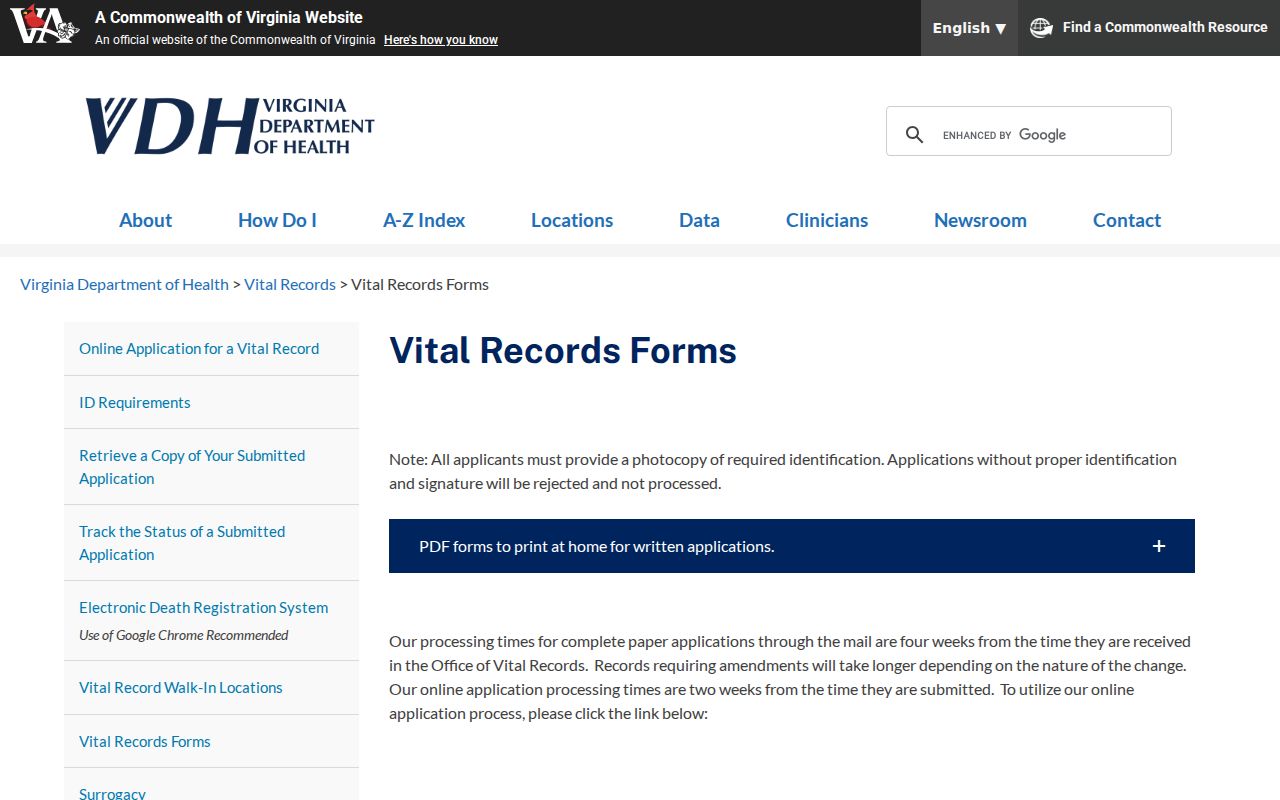
The form choices keep a Culpeper resident lookup pointed at the right custodian and request type. An index is not a certificate. Older records take a different path. The Library of Virginia holds surviving public birth and death microfilm from 1853 through 1896, plus marriage records before 1936. The Culpeper Clerk and local library hold more. They add locally kept historical indexes and marriage-register research. Those archival sources can fill a date gap, but they do not remove the disclosure rules for a newer VDH certificate.
Verify Culpeper Resident Records
Verification works best when one result is anchored to a second record. That second record should come from a different custodian. Start from the firmest fact you hold. An exact property address or a court case number usually works. Never merge two Culpeper entries just because the surname matches. Common names travel across neighborhoods and generations here. Remember what each tool actually is. A court docket lists indexed case events, not a life story. An index is only a finding aid. The image or paper file behind it is the real record once released.
- Search the Culpeper assessment database or WebGIS when an address or property interest is known. Record the owner name, tax-map number, situs, and mailing address as separate fields.
- Search OCIS with the exact name, then test a middle initial, suffix, or alternate spelling while keeping the Culpeper court selection and search date.
- Compare the case date or parcel detail with a second lawful source, such as the Clerk’s SRA index, a public VDH index, probate material, or a public entity filing.
- Request the specific file, instrument, or certificate from its custodian only when the remaining question requires it and the access rule allows it.
- Docket
- A court’s list of case activity and scheduled events. A scheduled hearing should not be read as a final decision.
- Index versus image
- An index points to a record by name, number, or date. An image or paper copy is the record itself and may have a different access route.
- Certified copy
- A copy issued or authenticated by the responsible custodian for an official purpose, subject to that office’s eligibility and fee rules.
Sometimes an address question grows into curiosity about every parcel on the block. The Culpeper street directory lays out that parcel-by-parcel workflow. It keeps a name search from being mistaken for a full list of current residents.
Culpeper Public Affiliation Records
Public entity and credential records can separate two Culpeper residents who share a name. The Virginia SCC Clerk’s Information System searches by entity name and ID. Its results can show name, type, status, address, formation date, registered agent, and filings. DPOR takes a different approach. That agency permits lookup by text, name, license number, address, or license type. Treat these as affiliation clues only. They do not prove an address is someone’s private residence. The Virginia SCC CIS is the official entry point for entity searches. It also covers filing searches.
An entity identifier, status date, and registered-office type can test whether a match holds up. Keep that data separate from parcel and voter details in a Culpeper resident lookup, so affiliation evidence never blends into residence evidence.
Culpeper Chancery Record Story
A former Culpeper resident can leave a dated trail. Historic newspapers, the County Library's local-history resources, deeds, obituaries, probate, and the Library of Virginia's chancery index all feed into it. Culpeper chancery causes from 1829 through 1913 are indexed there. The Library of Virginia has also digitally reformatted them. An old archive fallback is now an online path. It can reach an estate, a property, or a family connection.
Chancery material is not a current-resident record. A case can identify parties, property, heirs, or a dispute from its own era. Search a surname with the locality. Write down the local case number. Then weigh the date and parties against a deed, fiduciary entry, obituary, or other independent source. One caution belongs here. Many loose records and some minute books before 1840 are missing. The likely cause is Civil War events at the courthouse. A no-result may therefore reflect a survival problem, not proof that the person was never in Culpeper.
Culpeper Record Correction Routes
Correct a record where it began. Assessment errors belong to the Assessor. Court index problems go to the Clerk. Vital-record corrections go to VDH, and voter issues to the Registrar. Keep the source URL, the record or case number, and the image date. Also note the exact field that looks wrong. That gives the custodian one specific item to inspect. It beats a broad complaint about a name.
When an online result skips the year you need, Culpeper offers a fallback chain: the courthouse counter, the County Library’s microfilm and local-history room, the Library of Virginia archive, a mail request, or a narrow public-records request. A narrower option sits at the end of that chain. Under the Virginia Freedom of Information Act, a public body must respond within five working days. The statute’s response options still apply. Name the custodian, the record type, and the date range. Include any case or instrument number and your preferred format. The County also runs a NextRequest route for its own requests.
Note: FOIA can reach an existing public record. It does not require Culpeper to build a new dossier on a person.
Culpeper Resident Lookup Limits
Virginia keeps certain information out of any resident lookup. The Address Confidentiality Program under Va. Code §2.2-515.2 gives qualifying victims a designated address and limits disclosure of the real one. Crime-victim and witness rules can shield identifying contact details too. Voter SSNs are never open to public inspection. DMV, utility, delivery, sealed, and protected court files are not ordinary public resident sources.
Lawful use. Use Culpeper public records for personal, lawful research and respect protected information. Stalking, harassment, threats, or attempts to harm another person can violate Virginia law.
Records change, and indexes stay incomplete. A current official result beats a compiled listing because it names the custodian, the record type, the date, and the correction route. If a match stays uncertain, preserve that uncertainty rather than attaching one person’s record to another with the same name.