
Culpeper City Directory Holdings
Printed directory material is a verified research category at the Culpeper County Library, but the library's public page does not publish a complete Culpeper publisher-and-year run. That distinction matters. A catalog search or a call to the local-history room should establish the volume title, publisher, date, call number, and whether a reverse section exists before a result is treated as a directory entry. Statewide digitized collections can supply leads, yet their Culpeper titles must be checked one title at a time. A missing listing in one catalog does not prove that no local volume survives.
| Research material | Period represented | Custody | How to use it |
|---|---|---|---|
| Local-history city-directory material | Exact Culpeper years not published online | Julie Bushong Local History Room | On-site, noncirculating; verify title, shelf, publisher, and year |
| Virginia city and business directory collection | 1801-1929 statewide collection | William & Mary Libraries | Digitized collection; confirm a Culpeper title before citing it |
| Culpeper newspapers | Late 1890s forward, title dependent | County Library and Library of Virginia holdings | Microfilm and catalog-based follow-up |
| Historic voter lists | Circa 1898-1956 | Library of Virginia | Unrestricted archival resident layer |
| Sanborn town sheets | 1924 confirmed at Library of Congress | Library of Congress | Free map image for street and building context |
The collection table is intentionally a custody map, not a claimed printed-directory run. Ask the library to check the shelf and catalog first. If an address-to-name section is absent, use dated newspapers, deeds, voter books, and the 1924 map as separate evidence rather than filling the gap with an assumed volume.
Julie Bushong's Culpeper Directory Room
The Julie Bushong Local History Room is the first local stop for Culpeper historical directory work. It is at the Culpeper County Library, 271 Southgate Shopping Center, Culpeper, VA 22701, and its materials stay on site. The posted schedule is Monday through Wednesday from 10 a.m. to 8 p.m., Thursday through Saturday from 10 a.m. to 5 p.m., and closed Sunday. The library lists (540) 825-8691 for the building. Call before a trip when a particular directory, reel, family file, or obituary source is essential, since staff can check what is available and whether a local item needs room use.
The room also changes what counts as a useful substitute. It holds Culpeper and nearby county histories, Germanna-colonist material, colonial Virginia records, compiled family histories, vertical files on local names and topics, and Civil War publications. Its reader-printer serves microfilm and prints at 25 cents per page. The microfilm collection includes the Culpeper Exponent, Virginia Star, Culpeper Star-Exponent, Culpeper News, and Culpeper Times, along with Will Books 1749-1868, Deed Books 1749-1864, and Marriage Registers 1781-1897.
The Culpeper County Library local-history page identifies the room, its microfilm, and the local research services.
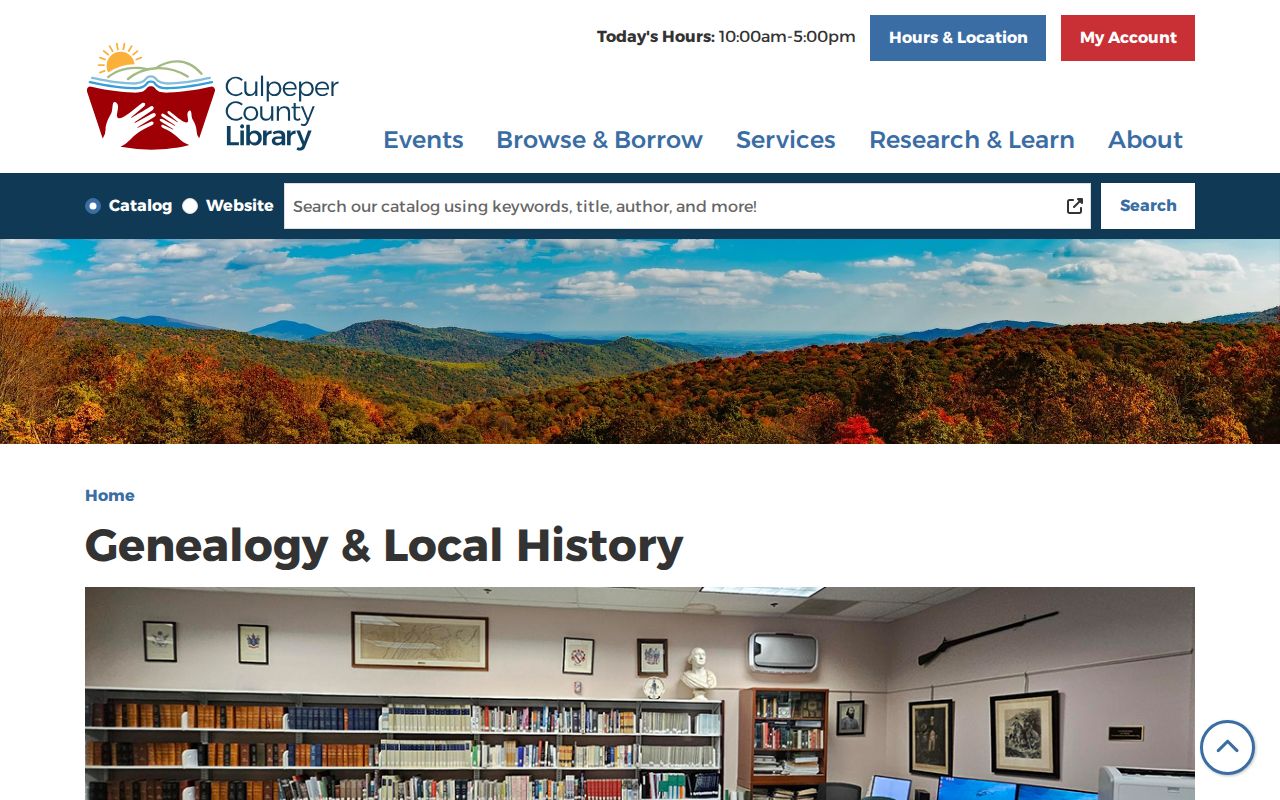
That local shelf is the right place to confirm an actual Culpeper volume before copying an entry, a year range, or a publisher name into research notes.
Note: Noncirculating material means the page, volume year, and abbreviation key should be recorded while the item is in hand.
Culpeper Directory Catalog Checks
Directory research in Culpeper begins with verification, not a presumed series. The official material confirms local city-directory resources, but it does not expose a complete scan or a year-by-year inventory. William & Mary's Virginia City and Business Directories collection is useful for checking historic personal and professional volumes, although each Culpeper result needs title-level confirmation. The Library of Virginia newspaper bibliography provides another source for title history and holding institutions.
Keep a simple source note for each find: repository, volume title, publisher, printed year, page, exact spelling, and whether the volume was created for that year or compiled later. One selected circa-1930 Virginia directory table does not list Culpeper. That absence is not a negative finding about local holdings. It only means the local room and responsible catalogs remain the place to confirm what can actually be consulted.
The CCLVA Digital Collection is an open repository for local family genealogy, business records, photographs, and related material.
The digital collection is a companion source, not proof that a digitized Culpeper city-directory item has been located. Item dates and descriptions should be read individually.
Reading a Culpeper City Directory Entry
No publicly viewable official sample of a Culpeper directory entry was located, so a local volume must supply its own evidence. Use the inventory below as a check-list, not as a claim that every entry includes every field. Photograph or transcribe the abbreviation key before interpreting short marks. A street number can identify a residence, an office, a shop, or a rural route, and a relationship note may be as important as the name itself.
| Name and variant | Check surname, given name, initials, suffix, and any alternate spelling printed in the volume. |
|---|---|
| Relationship notation | Check whether a spouse, widow, or other relationship appears in parentheses or a shortened form. |
| Occupation or business | Record only if the Culpeper entry prints it, along with any named business location. |
| Address type | Identify whether the number refers to a residence, business, office, shop, or rural route. |
| Ownership or occupancy mark | Check the volume's key before treating a symbol as an owner, renter, or other status. |
| Page evidence | Save the page, volume year, publisher, street spelling, and a legible image or citation. |
- Criss-cross directory
- A street-order section, when a volume includes one, that can be checked from an address toward an occupant or business listing.
- Householder index
- An index organized around household heads or addresses when the particular volume provides that arrangement.
- Abbreviation key
- The printed explanation of the volume's shortened terms and symbols. Read it before assigning a meaning to a mark.
A city directory can be an annual snapshot assembled before publication. It should not be read as a census of every person at the address. Compare its spellings and address with a dated record held by the relevant custodian when identity matters.
Culpeper Newspapers Between Directory Years
Local newspapers help fill the spaces when a Culpeper directory has no verified year or an entry disappears. The County Library microfilm reaches back to the late 1890s for several local titles, while the Library of Virginia bibliography identifies title histories and holding institutions. Search the surname with initials, a maiden name, a business name, and a street or rural community where known. Notices about moves, sales, deaths, civic events, and obituaries can supply dates that a directory alone cannot establish.
Newspaper material also helps distinguish a person from a similarly named neighbor. A result may point to a residence, but the wording and date still need to be compared with the actual directory page, a voter book, a deed description, or a cemetery record. The local library's Heritage Hub and reader-printer give practical in-person routes when a web search is thin. Preserve the newspaper title and issue date with each clipping or print.
Fairfax Names in Culpeper Directories
Historical locality names can hide a useful result. The town was established as Fairfax in 1759 and officially changed its name to Culpeper in 1870. Older material can therefore use Fairfax, Culpeper, or Culpeper Courthouse. Search all three when a family appears near the town across the eighteenth and nineteenth centuries. For roots before the county's 1749 formation, include Orange County as well.
The name bridge matters even when a city directory is the goal. An old deed, newspaper notice, family history, or catalog record may preserve the earlier locality rather than today's town name. It also helps explain why a current street, postal city, precinct, or town boundary is not a safe label for a much older household. Keep the exact place name printed by the source alongside the modern research label.
The Museum of Culpeper History research-resources page points researchers toward local historical and archival contacts.

The museum offers local context and family-history leads, but its resource page cautions that not all collection information is public or itemized online.
Culpeper Historic Voter Records
The Library of Virginia holds unrestricted Culpeper County voter lists from about 1898 through 1956. They are a strong historic resident layer beside a directory volume because the described fields include registration date, voter number, name, date of birth, age, occupation, residence, time in Virginia, county and precinct, poll-tax exemption, naturalization details, and precinct-transfer information. Those fields can help separate namesakes or show that a person changed precinct or residence between dated records.
Use a voter-list result as archival evidence for its registration period, not as a statement about a person's current status. The most reliable comparison pairs the list date with a directory page, newspaper mention, census household, or parcel record. The Library of Virginia voter-list catalog identifies the Culpeper collection and its field descriptions.
Tracing Culpeper City Directory Households
A household trail works best when every item has a date. Start with the newest verified directory volume, then move both backward and forward through the available shelf. Record each address change, spelling change, relationship note, and business reference without assuming that a gap means a move or a death. A record may be absent because the publisher did not cover that area, the person was omitted, or the shelf has not yet been verified.
- Locate the known surname in a verified volume and copy the printed form, page, year, and address type.
- Check nearby available years for the surname and street, noting moves, initials, widow notation, or changed business wording only where printed.
- Use a reverse or criss-cross section only if that particular volume has one and its key supports the reading.
- Pair dated entries with the public federal censuses for 1900, 1910, 1920, 1930, 1940, and 1950 to compare household members, relationships, age, birthplace, and address.
- Use newspapers, voter lists, deeds, cemetery material, or probate records to test an unexplained gap.
The 1890 federal census loss makes the space between 1880 and 1900 especially dependent on surviving local sources. The 1950 census is the newest released individual census, and 1960 is scheduled for release in 2032. When a Culpeper city directory find needs a current parcel or street-level cross-check, use the Culpeper street directory for the modern address record chain.
Note: A household can vanish from a volume for many reasons, so resolve the question with a second dated record before drawing a conclusion.
Sanborn Maps for Culpeper Directory Work
The Library of Congress provides a free May 1924, five-sheet Sanborn map for Culpeper. It places an address in a period street setting and can show building footprints and nearby streets without claiming who occupied a building. Local historic-survey references also cite 1915, 1924, 1931, and 1958 sheets, but the repository and availability of years other than the confirmed 1924 item should be checked before relying on them.
Use the map after an entry is transcribed, not in place of it. Compare a printed street form with the map, then carry the legal or parcel question to the Clerk's deed records. The 1924 Culpeper Sanborn map at the Library of Congress is a useful fixed-date companion to the local shelves.