
Culpeper Previous Residents by Era
Start with the era rather than a guessed old street number. The Culpeper trail runs from the current assessment parcel to the remote land index, historical deed books, archival voter lists, household sources, and building evidence. Each source answers a narrower question. A deed establishes a transfer. A census or confirmed directory entry may place a household in a period. A map dates a structure or street context. None should be treated as a complete answer by itself.
| Historical source | Era available | Culpeper holding place | What it can establish |
|---|---|---|---|
| Current assessment | Data through December 31, 2025 | Vision eAssessor / Assessor | Current owner, parcel, situs, mailing address, and property context |
| SRA land index | July 1, 1946 to present | Remote SRA and Circuit Court Clerk | Grantor, grantee, instrument, tax-map, and recording trail |
| Early deed books | 1749 to 1864 on local microfilm | County Library, Clerk, and Library of Virginia | Transfers and legal descriptions in early books |
| Historic voter lists | Circa 1898 to 1956 | Library of Virginia | Residence, age or DOB, precinct, and transfer details |
| Chancery causes | 1829 to 1913 | Library of Virginia Chancery Records Index | Property, estate, and relationship evidence |
| Newspapers | Late 1890s forward, title-dependent | County Library and Library of Virginia | Moves, sales, obituaries, and public notices |
| Sanborn map | 1924 item located | Library of Congress | Building footprint and period street setting |
| Permit reports | 2015 to 2026 | County Building and Town zoning | Project and inspection dates tied to an address |
| Federal census | Public individual schedules through 1950 | Library databases and federal sources | Household, relationship, age, and address snapshots |
Previous residents research normally starts with Vision when the parcel is known. Move to the deed index for owners and transfers. Use the library, Library of Virginia, and census layer after the time period is clear. The records room, microfilm, and archive are necessary routes when the remote index or a current portal does not reach the needed year.
Note: Match each source to the date being tested, because a later owner or mailing contact may not describe an earlier household.
Culpeper Parcel Before Old Numbers
A present-day street number is a useful locator, but the parcel is the stronger historical anchor. In the Culpeper Vision eAssessor, record the owner name exactly as displayed, tax-map identifier, situs, mailing address, acreage, and any visible deed or sales reference. The mailing address may be a different town, route, or post-office box. It is a correspondence clue, not a second physical location or proof of occupancy.
Then use Culpeper County WebGIS to verify the parcel boundary and surrounding context. The county map supports address, owner, and tax-map searches, with zoning, topography, aerial photography, and voting or magisterial district layers. Map information is not a legal survey, so compare it with the deed’s legal description, lot or block, subdivision reference, and adjoining owners when an old address differs.
The address trail is simple in form: current address to parcel, parcel to current owner, owner to purchase deed, seller to an earlier purchase deed. The details make the trail reliable. Preserve the spelling, date, tax map, instrument number, book and page, and legal description at every link.
Culpeper 1946 Deed Index Divide
Previous residents research depends on recognizing Culpeper’s explicit index split. The current Virginia Secure Remote Access agreement covers land-record indexes from July 1, 1946 to the present. The Clerk’s records-room process uses a computer for records from 1996 forward and a special index for July 1, 1946 through December 31, 1995. Earlier land research moves to grantor and grantee books by surname and likely year.
The Library of Virginia Culpeper County microfilm catalog leads to the archival fallback for land, court, fiduciary, marriage, town, business, tax, and vital records. The County Library also has Culpeper Deed Books from 1749 to 1864 on microfilm. The screenshot below is a direct view of that archival catalog route.
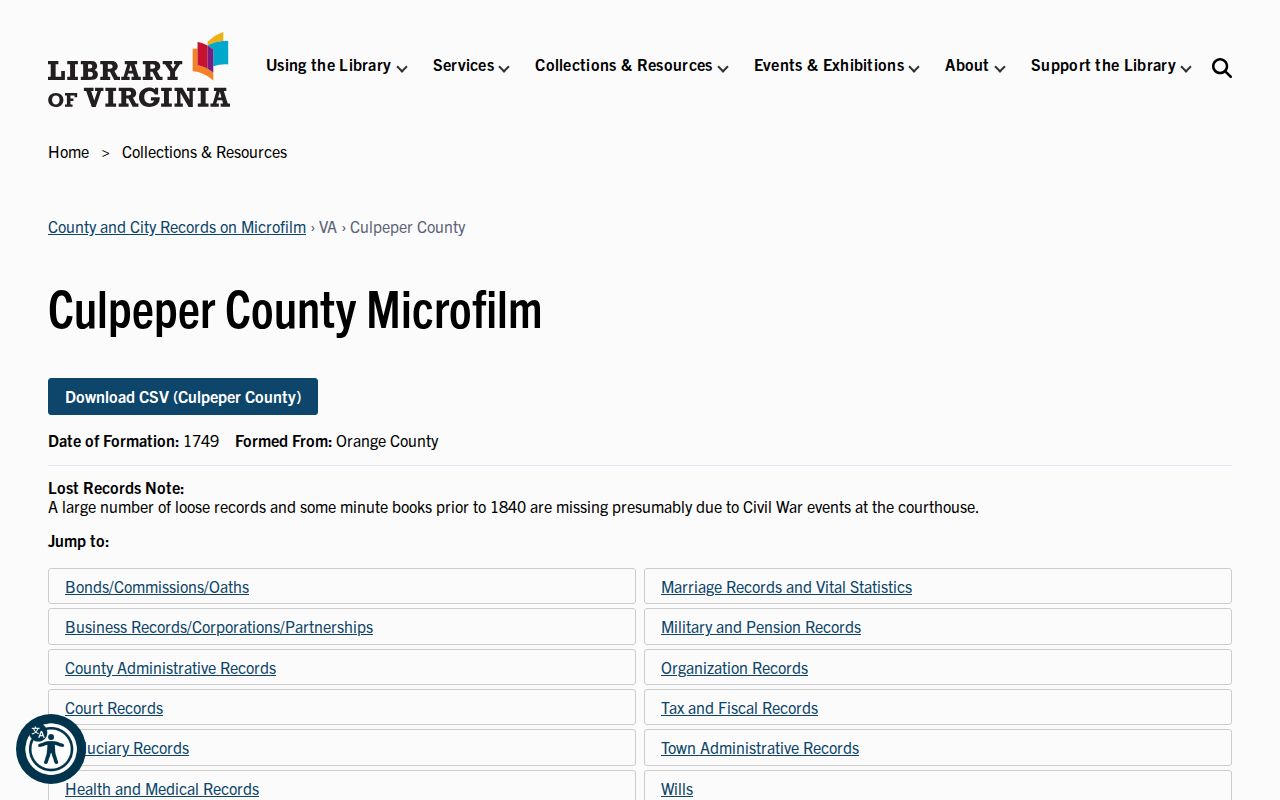
Older online coverage and original custody are not the same thing. The Circuit Court Clerk remains the custodian for deeds and land records reaching to 1749, while scans and uploads can be incomplete for early volumes. Culpeper’s records room, the County Library’s reels, and the Library of Virginia are the practical alternatives when the remote trail stops.
Note: A no-result in the remote index can identify an era problem rather than a missing historical transfer.
Trace Culpeper Previous Owners
Use the chain of title to move from a known owner to earlier owners. A deed can identify the seller and buyer, recording date, instrument number, book and page, tax map, legal description, and a prior-deed reference. The key move is to search the later seller as an earlier grantee. That turns a current transfer into a backward property trail. If an estate, trust, corporation, or several relatives appear, search each named party and the entity.
- Pull the current owner, parcel, situs, and legal description from Vision or the selected assessment record.
- Find that owner’s purchase record in SRA or at the Circuit Court Clerk’s public terminal, then copy the instrument or book-and-page reference.
- Record the grantor, grantee, date, tax map, legal description, subdivision or plat reference, and any prior-deed citation.
- Search the seller as a grantee to locate the earlier acquisition, then repeat the same comparison.
- At the pre-July 1946 divide, use the Clerk’s grantor and grantee books or the local deed microfilm rather than assuming a remote image exists.
- Grantor and grantee
- The grantor transfers an interest in the property. The grantee receives it.
- Chain of title
- The sequence of recorded property transfers that connects one owner to an earlier owner.
- Legal description
- The deed’s land description, such as lot, block, subdivision, metes and bounds, or other parcel wording. It can remain useful when a street label changes.
- Instrument number
- A number assigned to a recorded document that helps the Clerk locate a copy or index entry.
Culpeper Chancery Cases, 1829–1913
Property history can end in an estate or dispute rather than a routine sale. The Library of Virginia Chancery Records Index holds searchable Culpeper chancery causes from 1829 through 1913. Processing, indexing, and digital reformatting of the Culpeper collection were completed in the recent project described by the Library. These cases can connect property, heirs, fiduciaries, and family relationships when a deed chain alone leaves a gap.
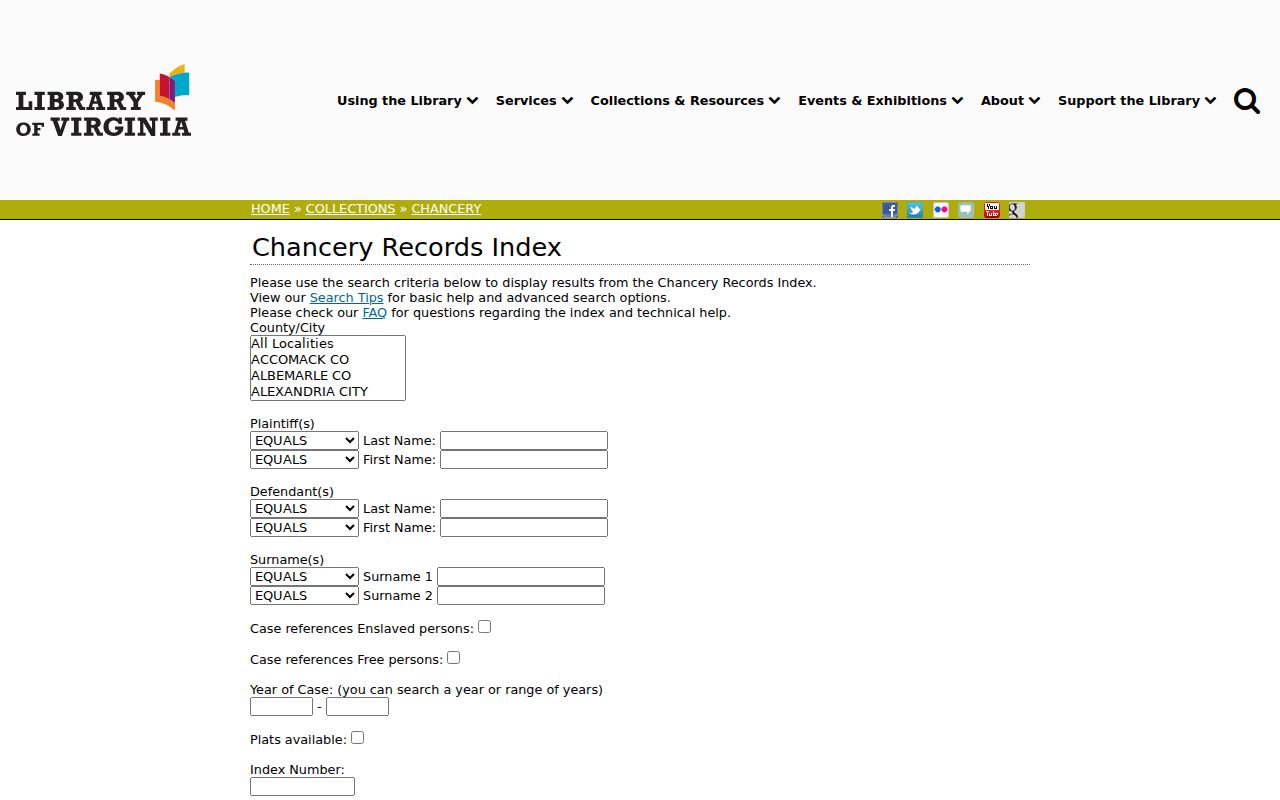
The chancery index is an archival property and family-history layer, not a current court locator. Use a case hit to identify names, land descriptions, or estate relationships, then return to deeds, probate records, and other dated sources. It can be especially useful where a transfer passed through a guardian, executor, or court-directed sale.
Some loose records and minute books before 1840 are missing, apparently because of Civil War events at the courthouse. That documented loss makes the Library of Virginia catalog, library microfilm, and surviving chancery images important ways to reconstruct a partial trail without claiming that every record survived.
Culpeper 1924 House Snapshot
The May 1924 five-sheet Library of Congress Culpeper Sanborn map is a free public-domain snapshot of the built town. Sanborn sheets can show building footprints, construction materials, stories, use, street names, and nearby structures. They help answer whether a building or street setting existed in that period. They do not name every resident or prove that a particular household lived there.
Pair the map with a deed, a verified directory entry, a newspaper notice, or a census schedule. Historic-survey material also cites Culpeper Sanborn years of 1915, 1931, and 1958, but the repository for each should be confirmed before treating those as available for a specific address. A map comparison is strongest when the lot, block, adjoining structures, and legal description agree.
For recent change, county permit inquiry uses permit number and year, while monthly reports cover 2015 through 2026. Routine completed permit files have a three-year retention period. A permit can date work and inspection activity, but it does not establish the prior residents of the address.
Note: Treat a building footprint or permit as date evidence, then seek a separate household record for the people connected to it.
Culpeper Past Households and Census
Owners are only one part of the address history. Culpeper’s County Library local-history room holds city-directory material as a research category, but its public page does not publish a complete Culpeper publisher and year list. Ask staff to confirm the shelf, year, publisher, and whether a reverse or criss-cross volume exists. The collection workflow belongs with the Culpeper city directory resources; for an address trail, use the confirmed volume as one dated household snapshot.
Federal individual census schedules are public through 1950 under the 72-year rule. Compare a directory year or newspaper clue with the public 1900, 1910, 1920, 1930, 1940, or 1950 schedules when the period fits. The 1890 census loss creates a gap, so prior residents research should turn to deeds, tax material, voter books, newspapers, churches, and other local records instead of treating silence as proof.
- Write down the directory year, page, street spelling, number, and whether the entry is a residence, office, shop, or rural route.
- Check the volume’s own abbreviation key before reading relationship, widowhood, owner, or occupancy notation.
- Pair the dated entry with the nearest public census and compare names, relationships, ages, birthplace, and address context.
- Use the parcel, deed legal description, and local newspaper notices to resolve a similar name or changed street form.
The Library of Virginia’s unrestricted Culpeper voter lists, circa 1898 to 1956, add another historical address layer. They can include registration date, voter number, name, age or DOB, occupation, residence, precinct, naturalization, and transfer information. Those fields can distinguish people with the same name, but they describe a historical registration period, not current status.
Culpeper Previous Residents and Fairfax
The town was established as Fairfax in 1759 and officially became Culpeper in 1870. Previous residents searches across that period should test Fairfax, Culpeper, and Culpeper Courthouse, along with old road names, street-type abbreviations, rural routes, initials, maiden names, and surname variants. The town and county also have layered geography, so a later mailing city or ZIP should not be projected backward into an older record.
Local newspapers provide a flexible bridge. The County Library microfilm includes the Culpeper Exponent, Virginia Star, Culpeper Star-Exponent, Culpeper News, and Culpeper Times from the late 1890s forward. The library’s open digital collection adds family genealogy, business records, photographs, and local material. For a trail endpoint, Horizon Funeral Home’s obituary archive, local newspapers, cemetery material, wills, fiduciary records, and probate files can identify relatives or a last residence, then point back to the deed record.
Note: Search the historic locality name and the current name separately, then compare the parcel or legal description before combining results.
Culpeper Previous Resident Limits
Historical public records can support a careful house history. They cannot supply a complete account of everyone who ever lived at an address. A property owner may not have occupied the parcel. A directory can be an annual snapshot gathered before publication. A census, voter-list entry, obituary, or permit answers a time-specific question. Non-owner occupants, unnamed household members, protected addresses, private association lists, utility customers, DMV customer data, and sealed material remain outside a normal address trail.
Lawful use. Culpeper previous residents research is appropriate for house history, family history, heirs, and personal curiosity. Do not use public records to stalk, harass, track, intimidate, or harm any living person.
When a public record is missing, ask for the smallest dated item that may exist, such as a referenced deed, plat, permit report, or archival reel. A focused Virginia FOIA request should identify the custodian, address or tax map, record type, and date range. The public body may withhold exempt fields and does not have to create a new history that it does not maintain.